Buying secondhand toys can save money and reduce waste, but safety must come first. Here’s a quick guide to ensure pre-owned toys are safe for children:
- Check for Recalls: Search the CPSC database for toy recalls before purchase.
- Inspect for Damage: Look for sharp edges, cracks, or splinters.
- Test for Choking Hazards: Use the toilet paper roll test for small parts.
- Verify Age Labels: Ensure the toy matches the child’s age and developmental stage.
- Examine Soft Toys: Check for loose parts, weak seams, and washability.
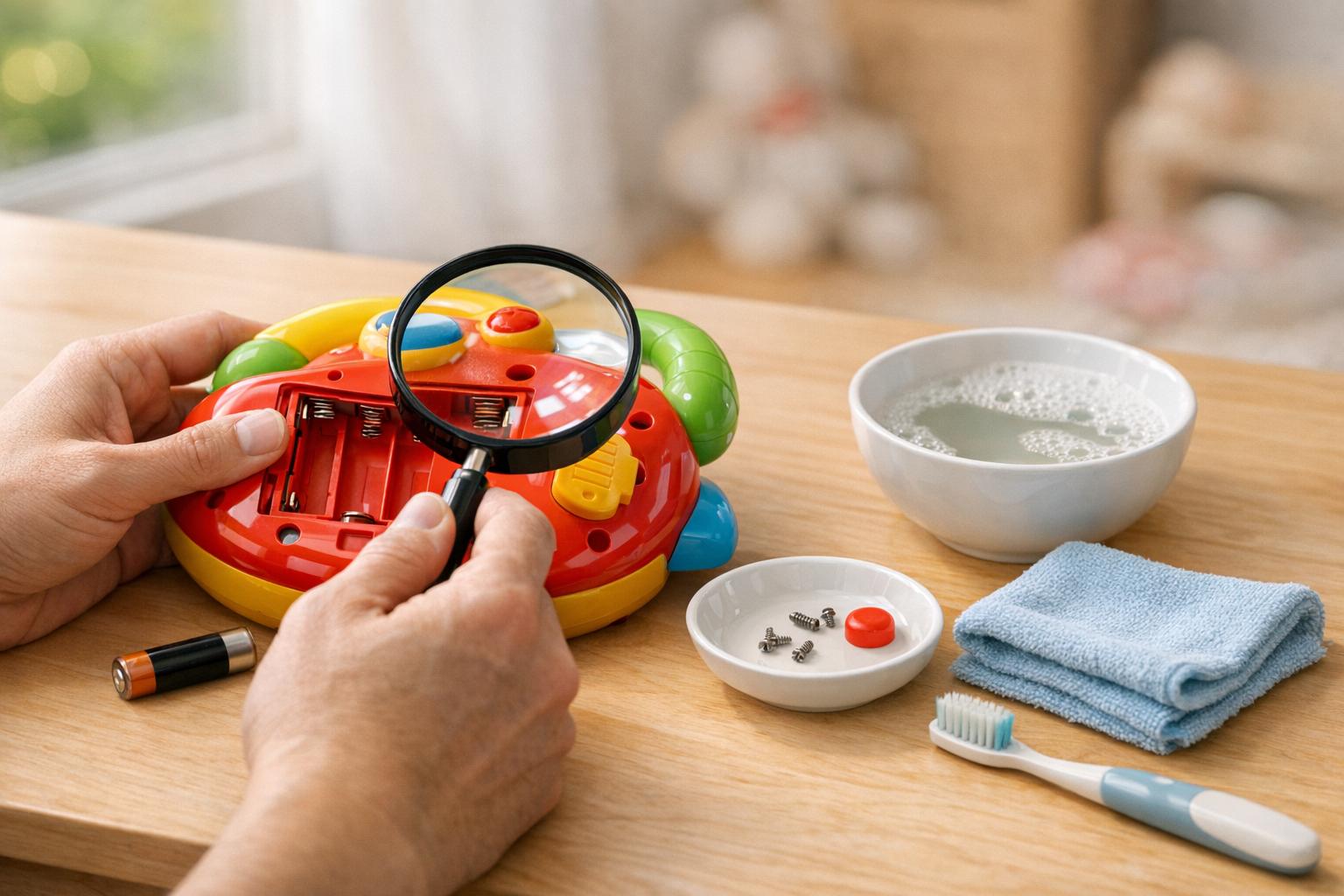
- Secure Battery Compartments: Ensure they are tightly sealed to prevent ingestion.
- Avoid Lead Paint: Be cautious with toys made before 2009 or vintage items.
- Check Magnets and Projectiles: Ensure they are intact and not easily detachable.
- Clean Thoroughly: Use appropriate cleaning methods for different toy materials.
- Keep Instructions: Save packaging and manuals for safety and usage details.
Key takeaway: Always inspect, clean, and verify secondhand toys to ensure they meet current safety standards. If in doubt, discard the toy to avoid risks.
1. Check for Recalls First
Before giving any secondhand toy to a child, it’s essential to take a moment and check the Consumer Product Safety Commission (CPSC) database. Head over to CPSC.gov or SaferProducts.gov, and search for the toy’s brand name and model. This quick step can help you avoid potential hazards like dangerous magnets, lead-based paint, or small parts that could become choking risks.
Once you’ve checked for recalls, make sure the toy has permanent tracking labels if it’s intended for children 12 and under. These labels – found on both the toy and its packaging – should include details like the manufacturer’s name, production date and location, and a batch number. This information is crucial for cross-referencing recall notices and confirming whether the toy in question is safe.
Under Section 19 of the Consumer Product Safety Act, it’s illegal to sell or distribute recalled products. This rule applies to everyone, from thrift stores and flea markets to individual sellers. For instance, in December 2006, Black Dog Tavern Company faced fines for failing to report the sale of previously recalled children’s sweatshirts.
Pay close attention to durable items for infants, like cribs and bassinets, as these are frequently subject to recalls. When reviewing a recall notice, check the “Remedy” section to see if the issue can be resolved with a refund, replacement, or repair. Many notices also specify where and when the product was sold – for example, “Sold on Amazon from January 2023 through May 2024” – to help you determine if your item is affected.
To stay ahead of potential risks, consider signing up for CPSC email alerts. These notifications will keep you updated on new recalls as they happen. And if you come across a toy that doesn’t have a tracking label or whose recall status can’t be confirmed, it’s safest to discard it right away.
If you’re shopping for secondhand toys at places like City Thrift, taking these precautions ensures you’re selecting toys that are not only fun but also safe for kids.
2. Inspect for Sharp Edges and Points
Once you’ve ensured there are no recalls, take a moment to run your hand over the toy’s surface. Feel for cracks, jagged edges, or snags that could pose a risk. Federal safety standards, like ASTM F963, specifically address “accessible edges” and “accessible points” to prevent injuries during normal use. However, secondhand toys may develop new hazards over time, making this step especially important.
Pay close attention to damaged components. Plastic toys can crack as they age, forming sharp burrs along the edges. Wooden toys, on the other hand, might splinter or reveal nails and staples that were previously hidden beneath the surface. You can also perform a simple “wiggle test” on small parts like doll eyes or toy car wheels – loose pieces could expose sharp internal components.
“Toys should not include sharp ends or small parts like eyes, wheels, or buttons that can be pulled loose…” – UCSF Benioff Children’s Hospitals
For projectile toys, such as dart guns, check that the darts have soft tips rather than hard or sharpened points. Toy chests deserve a quick inspection, too – make sure hinges are safe, and corners are smooth. Larger items, like ride-on toys or play furniture, should feel stable. If they wobble, it could mean the screws are loose or the hinges are bent, which could pinch or cut.
If you come across toys with exposed metal rods, brittle wood, or cracked plastic that reveals sharp edges, it’s best to discard them. Let’s move on to the next step: tackling the hazards of small parts.
3. Test Small Parts for Choking Hazards
When inspecting toys, it’s crucial to test small parts for choking risks. Young children have a tendency to put things in their mouths, and any item small enough to fit through a toilet paper roll could pose a danger.
The toilet paper roll test is a simple yet effective way to check for choking hazards. Take an empty toilet paper roll and attempt to pass the toy or any detachable parts through it. If the item fits entirely inside the roll, it’s too small for children under 3 years old. This includes obvious items like marbles and small balls, but also less apparent risks such as buttons on stuffed animals, wheels on toy cars, or plastic eyes on dolls.
“To prevent choking in kids 3 or younger, make sure that toys and parts cannot fit inside an empty toilet paper tube.” – Seattle Children’s
Additionally, pull on decorative features like buttons, ribbons, eyes, or noses to ensure they are securely attached. Be cautious with soft toys too – compressible materials can sometimes conceal small parts when squeezed. Federal regulations prohibit small parts in toys designed for children under 3, and such items must carry a warning label stating, “Not suitable for children under 36 months“.
Another major concern is latex balloons. Both inflated and deflated pieces are among the leading choking hazards for young children. For secondhand toys, always perform these checks to ensure they meet safety standards.
4. Verify Age Grading Labels
Once you’ve ensured a toy is physically safe, the next step is to check that its age labeling aligns with the child’s developmental stage. These labels are there for a reason – they reflect safety considerations like choking risks, physical strength requirements, and the materials used in the toy’s construction. For example, a toy labeled for ages 5 and up might include small parts or other features that could be hazardous to younger children.
“The age levels for toys are determined by safety factors, not intelligence or maturity.” – UCSF Benioff Children’s Hospitals
By law, toys that present choking hazards for kids under 3 must include age warnings. If the label is missing or illegible, look for permanent tracking marks. These marks usually provide details about the manufacturer, production date, and location. With this information, you can often find the original age recommendations and safety details on the manufacturer’s website. This step is a crucial safeguard to ensure the toy is suitable for the child’s age.
If a toy lacks proper labeling, take extra precautions. Check for small, detachable components or unsecured battery compartments that could pose risks. When in doubt about whether a toy is age-appropriate or safe, it’s always better to skip it.
Keep in mind that toys produced before 2008 might not meet current safety standards. For instance, modern regulations limit paint to a maximum of 90 ppm lead, while accessible parts must not exceed 100 ppm lead or 1,000 ppm regulated phthalates.
5. Examine Soft Toys Thoroughly
Once you’ve inspected the structural elements of toys, shift your focus to soft toys, as they can conceal hidden risks. Stuffed animals and plush toys, in particular, need a closer look because their design can mask potential dangers. Begin by gently tugging on any attachments – like eyes, buttons, ribbons, or decorative pieces – to ensure they’re securely attached and won’t pose a choking hazard. As Onney Crawley, Chief Marketing Officer at Goodwill Industries International, suggests:
Pillows, clothing and stuffed animals should always be laundered in a washing machine with hypoallergenic laundry detergent.
Check every seam by squeezing and pulling lightly to identify any weak stitching that might allow stuffing or pellets to escape. Additionally, look for labels that confirm the toy is “washable” and “flame resistant” (or “flame retardant”), which are critical safety indicators.
Pay attention to strings, ribbons, or cords – anything longer than 7 inches should be removed to eliminate strangulation risks.
Be alert for signs of allergens or mold, such as musty smells or discoloration. If you can’t wash the toy right away, seal it in a bag and freeze it for 24 hours or use steam cleaning to kill bacteria and dust mites.
For children under three, avoid soft toys with plastic eyes or glued-on parts, as these could break off and become hazards. Always clean secondhand toys thoroughly before use to reduce the risk of respiratory issues and skin irritations. Regular cleaning and detailed inspections are essential to ensure the safety of all pre-owned toys.
6. Assess Battery Compartments Securely
Battery compartments in toys, particularly those using button or coin batteries, must be tightly secured. Swallowed batteries can cause severe damage, burning a child’s esophagus in as little as two hours. From 2011 to 2021, an estimated 54,300 emergency room visits and 27 fatalities were linked to button battery ingestion or insertion.
To ensure safety, battery compartments should require a tool (like a screwdriver or coin) or two independent hand movements to open. Federal safety standards (ANSI/UL 4200A-2023) enforce these requirements. A simple test: try opening the compartment with your fingernail. If it opens without a tool, the toy does not meet safety standards and should be avoided.
“When a child swallows a button battery, the battery can get stuck in the esophagus. This could result in a caustic injury to the esophagus causing infection, internal bleeding, serious burn injuries or even death.”– Mark Molitor, MD, Pediatric Surgeon, Phoenix Children’s
Regularly check that the battery compartment is intact. Ensure screws are secure and the surrounding plastic is undamaged. If the cover is cracked or a screw is missing, discard the toy immediately. Avoid makeshift repairs, such as using tape, as they do not provide sufficient protection.
In the event of battery ingestion, seek medical attention immediately. For children over 12 months old, administer 10 mL (2 teaspoons) of honey every 10 minutes (up to six doses) while heading to the hospital. For additional help, contact the National Battery Ingestion Hotline at 1-800-498-8666.
7. Look for Lead Paint on Older Toys
Toys manufactured before 2009 might exceed today’s lead limits – 90 ppm in paint and 100 ppm in accessible parts – set to protect children from harmful exposure.
Older metal toys, often made from tin, brass, or pewter, and vintage toys with bright, vivid colors are particularly concerning. Back then, lead was commonly used in both the alloys and the paints. Even plastic toys aren’t exempt. Lead was added to plastics to increase flexibility and stabilize them against heat. However, over time, exposure to sunlight, air, or detergents can break down these plastics, releasing dangerous lead dust.
“Lead is used to soften plastic and to make it more flexible so that it can go back to its original shape… The chemical bond between the lead and plastics breaks down and forms a dust when the plastic is exposed to sunlight, air, or detergents.”– CDC
Given these risks, it’s crucial to check for lead before letting children play with older or vintage toys.
For a quick check, you can use home testing kits with swabs that change color when lead is detected. While some kits claim up to 96% accuracy, they’re not foolproof. For precise results, sending a sample to a certified lab is the best option.
The CDC strongly recommends keeping children away from toys made before 2009 or vintage collectibles. If you have a treasured antique toy, display it as a keepsake but keep it out of reach of children. Also, be vigilant about signs like chipped paint, cracks, or dust on plastic surfaces – these can signal a higher risk of lead exposure. When in doubt about a toy’s safety, follow the Consumer Product Safety Commission’s advice: “When in doubt, throw it out!”
8. Check Magnets and Projectiles
Small, high-powered magnets are some of the most dangerous components found in secondhand toys. If a child swallows two or more of these magnets, they can attract each other through the walls of the stomach or intestines. This can crush internal tissues, cut off blood flow, and lead to severe injuries or even death. Before allowing kids to play with any magnetic toys, perform a simple pull test. If the magnets come apart easily or if the casing is cracked, it’s time to toss the toy. Magnetic building sets deserve extra caution, and it’s best to avoid small magnetic balls or cubes altogether.
Projectile toys also require close inspection to avoid accidents. Toys like dart guns, arrows, or guided missiles can pose serious risks, particularly to the eyes. When evaluating secondhand projectile toys, make sure they have soft rubber tips or securely attached suction cups. Give each tip a firm tug to ensure it won’t come loose, and check that the toy can only fire its intended ammunition. Modifications that enable it to launch other objects can significantly increase the risk of injury.
If you decide to keep a projectile toy, make sure your child wears safety glasses or goggles during play. These toys are generally unsuitable for children under 5 years old. When inspecting secondhand launchers, look for signs of wear, such as cracked firing tubes or weakened springs, which could cause the toy to malfunction unpredictably.
The Consumer Product Safety Commission (CPSC) has a simple rule to follow: “When in doubt, throw it out!” If a toy with magnets or projectiles shows signs of damage, feels unstable, or has missing parts, it’s better to discard it than to risk your child’s safety.
9. Clean and Disinfect Properly
Once inspections are done, the next step is making sure every toy is clean and safe for kids to enjoy. Cleaning not only removes visible dirt but also gets rid of any unseen residues or contaminants. However, it’s important to use the right cleaning method for each material to avoid damage or leaving behind harmful substances.
Plastic Toys
Durable plastic toys can be cleaned on the top rack of a dishwasher or soaked in warm, soapy water. For a more thorough clean, mix 1/3 cup bleach with 1 gallon of water, then rinse well to ensure no residue remains. For smaller pieces, use a mesh bag to keep them contained during cleaning. If the toy is made of food-grade silicone, you can boil it for up to 5 minutes to sterilize it completely.
Wooden Toys
Wooden toys need special care because they’re porous and can absorb moisture. Avoid soaking them in water. Instead, wipe them with a damp cloth and mild soap or a 1:1 solution of vinegar and water. Amber Williams advises,
“Since wood is so porous, you cannot thoroughly disinfect it. Moreover, bleach water and other harmful chemicals will soak into the wood where it cannot be rinsed away easily.”
After cleaning, let wooden toys air-dry for at least 24 hours to prevent mold from forming.
Fabric and Plush Toys
Most fabric and plush toys can go in the washing machine on a gentle cycle. Use a hypoallergenic, fragrance-free detergent, and to protect the toy, place it in a mesh laundry bag or pillowcase. To avoid clumping in the dryer, toss in a few clean tennis balls. For toys that can’t be machine-washed, seal them in a bag and freeze for 24–48 hours to kill bacteria and pests like bed bugs or lice.
Electronic Toys
Electronic toys require extra care. Always remove the batteries before cleaning and use a microfiber cloth dampened with a 70% isopropyl alcohol or vinegar solution to gently wipe the surface. Never submerge these toys in water or spray them directly. For hard-to-reach spots like buttons or crevices, use cotton swabs. After cleaning, wipe the toy with a damp cloth to remove any leftover residue – especially important for toys that might end up in a child’s mouth.
Dr. Danette Swanson Glassy from the American Academy of Pediatrics reminds us,
“At home, cleaning is enough… unless someone sick with fever or diarrhea touches your children’s toys.”
10. Keep Instructions and Packaging Info
Hold onto the original packaging and manuals to ensure proper use and safety verification. Federal law mandates that toys for children aged 12 and under include permanent tracking marks on both the product and the packaging. These marks typically feature the manufacturer’s name, production location, date of manufacture, and batch or run numbers. Such details are crucial for identifying whether a toy has been recalled or if it might be a counterfeit posing safety risks.
If you’re short on storage space, take photos of tracking labels, UPCs, and safety warnings before discarding the packaging. Use your smartphone to create digital backups of labels and manuals, making it easy to access safety information later. Many mobile apps allow you to scan UPC or QR codes, often linking directly to the manufacturer’s website, where you can find digital manuals and check for safety updates. Teresa Murray, Consumer Watchdog Director at U.S. PIRG Education Fund, emphasizes the importance of age-grading labels:
“Age-grading isn’t about how intelligent a child is; it’s safety guidance based on the developmental skills and of children at a particular age.”
Keeping these records helps ensure ongoing safety checks and proper toy usage. Manuals often include instructions for assembly, battery installation, and cleaning – key to preventing injuries caused by misuse. For electric toys, make sure to note the UL-approval mark to confirm they meet safety standards. And if you’re ever unsure about a toy’s safety, the American Academy of Pediatrics suggests:
“If you’re not sure about a toy’s safety or proper use, call the manufacturer.”
For older toys, having documentation becomes even more important to identify potential hazards. Organize your digital copies by toy name so they’re easy to find when needed. This simple step ensures you have all the critical information at your fingertips if safety concerns arise.
Conclusion
Buying secondhand toys can save money, but ensuring they’re safe for your child is crucial. Start by checking for recalls through the U.S. Consumer Product Safety Commission (CPSC). Their advice is clear:
“When in doubt, throw it out!”
After checking recalls, take a close look at the toy itself. Look for sharp edges, broken parts, or missing pieces that could pose risks. Also, watch out for small parts or unsecured batteries that could be hazardous.
Once you’ve ensured the toy is physically safe, thorough cleaning is the final step. Secondhand toys may carry germs, allergens, or even mold. As Onney Crawley, Chief Marketing Officer at Goodwill Industries International, points out:
“Pillows, clothing and stuffed animals should always be laundered in a washing machine with hypoallergenic laundry detergent”
For toys that can’t go in the wash, use child-safe cleaning products, and if you’re ever unsure about what’s safe to use, consult your pediatrician.
Shopping at City Thrift in Kansas City not only helps you find quality secondhand toys but also supports impactful community initiatives. Your purchases contribute to the City Union Mission’s efforts to combat homelessness and poverty and benefit organizations like the Boys & Girls Clubs, Salvation Army, Disabled American Veterans, and Habitat for Humanity. Plus, you’re helping the environment by keeping toys out of landfills while supporting job training programs. By choosing carefully inspected and cleaned toys, you’re protecting your child and making a meaningful difference in your community.
FAQs
How can I make sure a secondhand toy doesn’t contain lead paint?
To make sure a secondhand toy doesn’t contain lead paint, start by carefully examining it for any signs of chipped, peeling, or faded paint. Toys produced before 1978 are more likely to have lead-based paint, so it’s wise to be extra cautious with older items.
For additional peace of mind, consider using a home lead test kit to check the toy. If the test confirms the presence of lead, it’s safest to dispose of the toy properly to avoid any risk to your child’s health. When shopping for secondhand toys, it’s always a good idea to focus on newer items or those specifically labeled as lead-free.
How can I safely clean secondhand toys for my kids?
To clean secondhand toys safely, the first step is figuring out what material the toy is made from so you can select the best cleaning method. For toys that can handle water, use warm, soapy water along with a cloth or brush to scrub them clean. Rinse them well and let them air-dry. If the toy is labeled as dishwasher-safe, you can also toss it in the dishwasher for a thorough clean. For fabric toys, check the care label to see if they can go in the washing machine, and use a hot cycle if possible.
For electronic or water-sensitive toys, avoid soaking them. Instead, wipe them down with a cloth dampened with rubbing alcohol (at least 70%) or a disinfectant wipe. Let the surface remain wet for a few seconds to ensure proper cleaning, then allow it to air-dry. If the toy might end up in a child’s mouth, rinse off any leftover residue just to be safe.
To disinfect toys, mix 1 tablespoon of bleach with 1 gallon of water. Apply the solution to the toy, let it sit for at least a minute, then rinse it thoroughly and let it dry completely. By taking these steps, you can make sure secondhand toys are clean, safe, and ready for little ones to enjoy.
Why should I check for recalls before buying secondhand toys?
When it comes to secondhand toys, checking for recalls is a step you shouldn’t skip. Some toys might have been pulled from the market due to safety concerns like choking hazards from small parts, sharp edges, or flaws in manufacturing that could cause injuries.
Taking the time to confirm that a toy hasn’t been recalled helps protect your child from these risks. Plus, it ensures the toy aligns with current safety regulations. It’s a quick and easy way to keep playtime safe and give yourself some peace of mind.